The Basics
Chemistry — Some Basics
The Atom
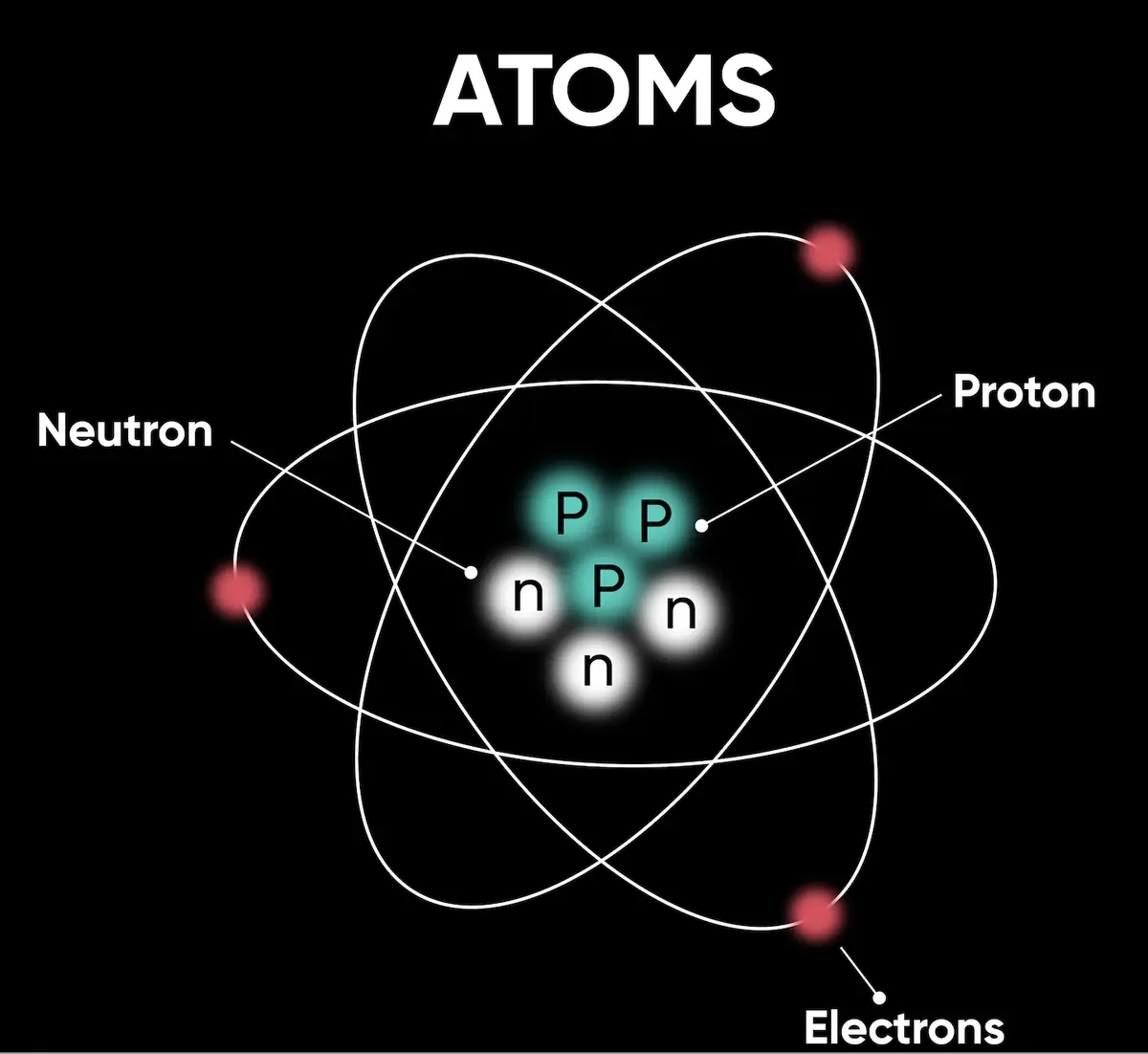
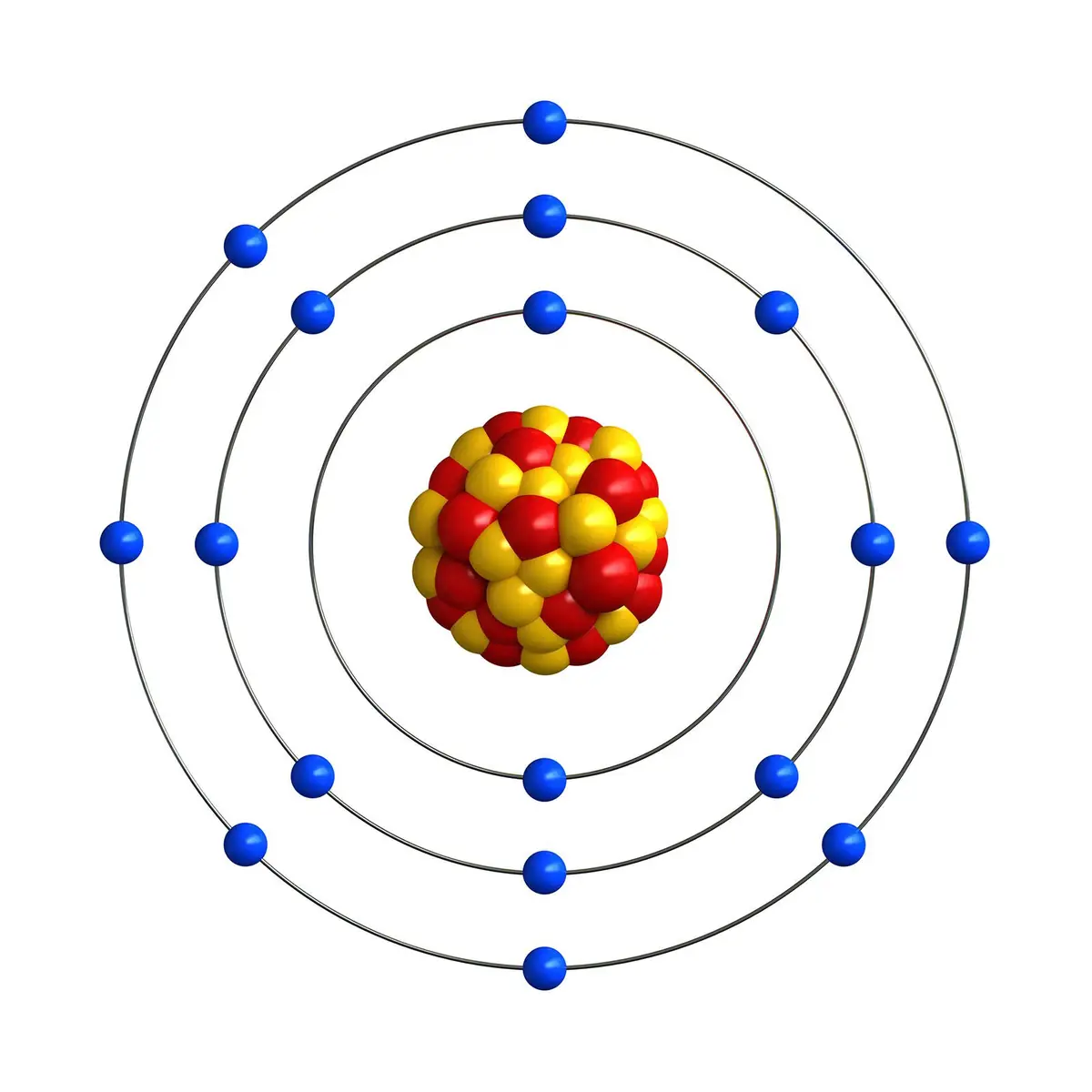
One might imagine an atom to be rather like the Earth with some satellites whizzing around it. Although the “ball in the middle” (called the nucleus) is actually a cluster of smaller balls, the real names of which are protons and neutrons, we do not really need to worry about that. What we do like to know is how many of the tiny balls (like satellites) are in orbit, buzzing around the outside.
These are what we call electrons, and they are arranged in levels, somewhat like the layers of an onion. These layers are called shells. The number of electrons and how they are grouped around the nucleus determines how an atom behaves when it gets near other atoms. We call this the reactivity of the atom. Protons have a positive charge and electrons have a negative charge, which is why a single atom has the same amount of each.
Elements
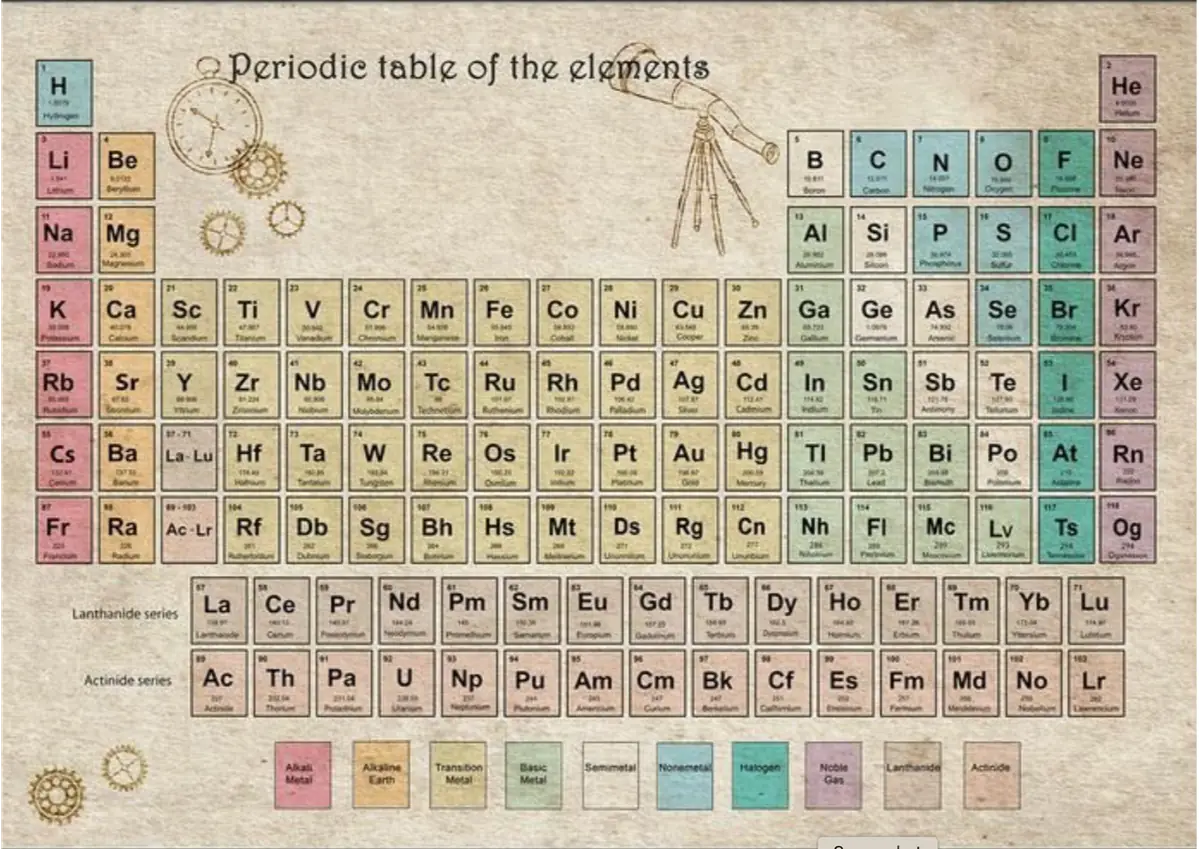
Most of us are familiar with substances which we can see and touch, like iron and aluminium, and those which we cannot, like oxygen and nitrogen. These are called elements. There are 118 of them, arranged in what is called the periodic table, which groups them according to their chemical properties.
Each element has an atomic number, which corresponds to the total number of electrons that it has. The weight of the element is the sum of the protons and neutrons; the electrons do not weigh enough to make any difference.
The periodic table shown in the original document is an older example, selected more for its look than anything else. Another sixteen elements have been added since it was produced. These have been synthesised in nuclear laboratories and are therefore not naturally occurring. Most of the elements in the bottom two rows (lanthanides and actinides) are unstable products forming part of the radioactive decay chain of uranium-235, which eventually ends up as lead, which is stable. Some elements only last for hours or even fractions of a second.
The number of electrons and how they are arranged around the nucleus is effectively the deciding factor in the chemical character of an atom and thus what element it is. This dictates its position within the periodic table.
Valence
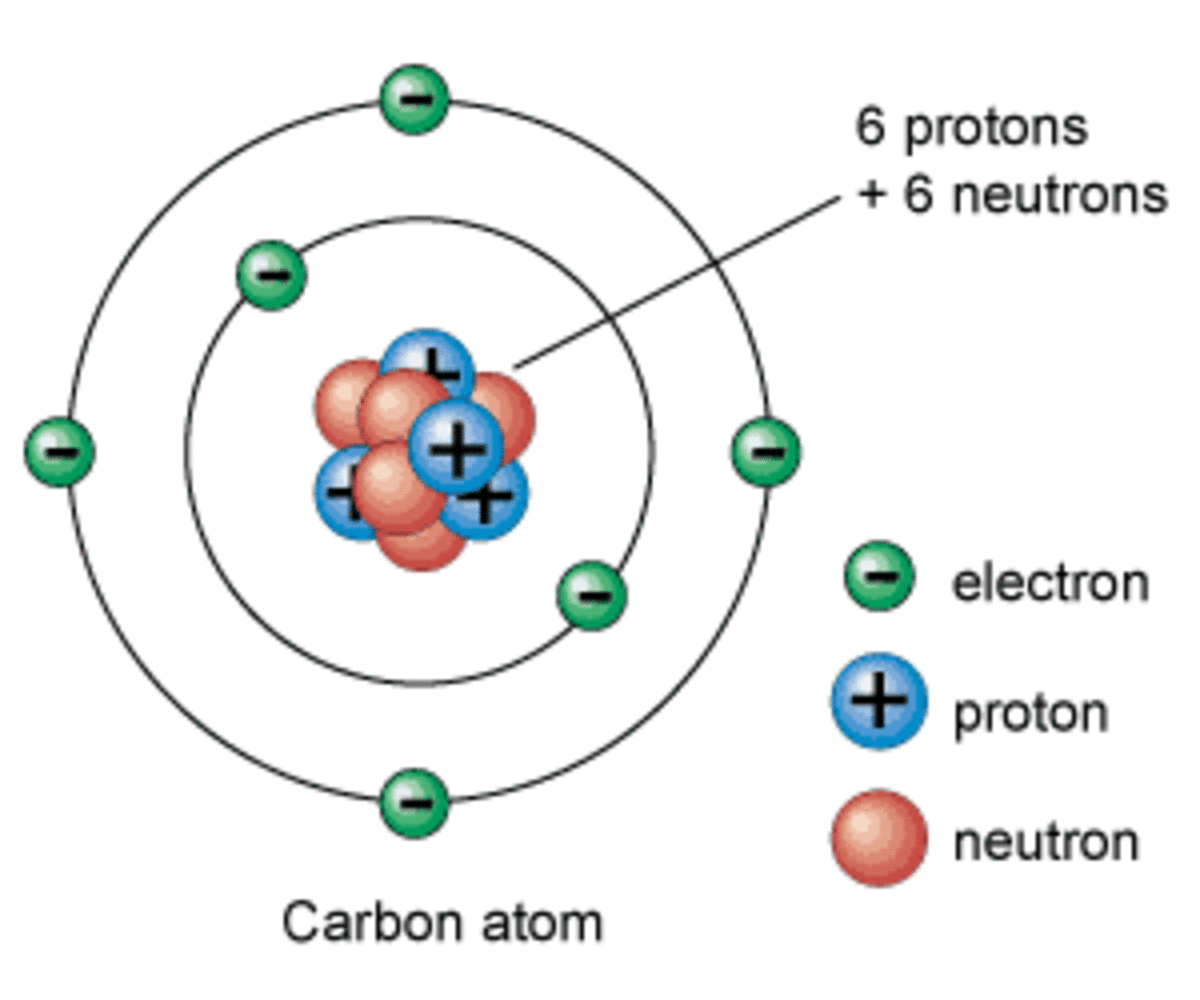
Electrons sit in shells; the bigger the number, the more shells. The key factor in determining the characteristics or reactivity of an element is the number of electrons in the outermost layer, called the valence shell.
In the example from the original document, carbon has six protons and therefore six electrons; four of them sit in the outer shell.
Octets
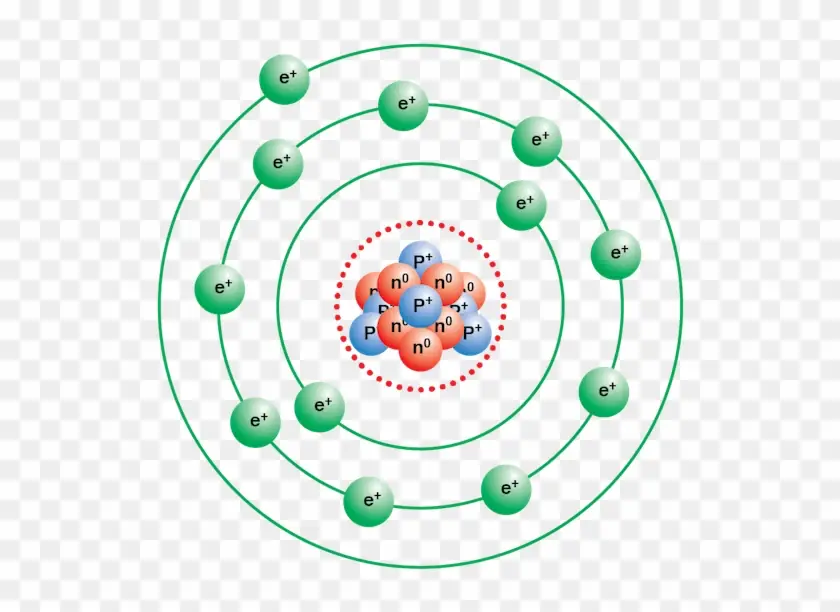
Every atom wants to be stable, which in straightforward terms means unreactive or not very reactive. In order to achieve this state, it needs a full outer shell. For every element (with the exception of hydrogen and helium), this means that eight electrons are needed in the outer or valence shell.
We can think of the situation as akin to a table which requires eight legs to stay upright. The other option, since the layer below will be full, is to give those legs away and get rid of the outer shell altogether.
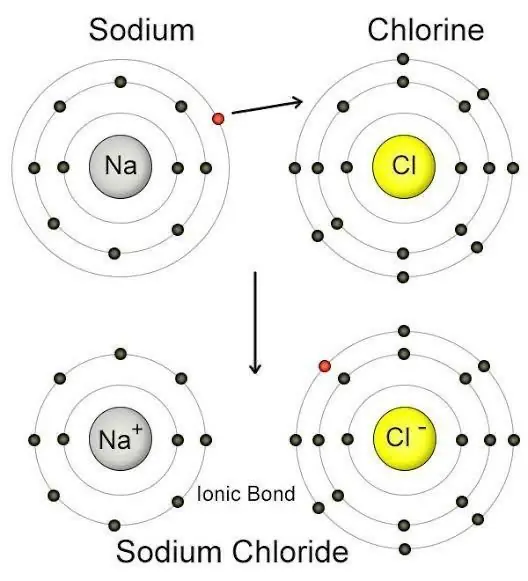
In general terms, if an atom only has one or two valence electrons, it will try to offload them, since the shell underneath will be full. Sodium is an example of this strategy, with a single valence electron. If it can give that away, shell 2 (which is full) will now be outermost, so sodium will be stable.
On the other hand, if the outer shell has six or seven electrons, the atom will want to borrow one or two from another atom to achieve its octet. Chlorine needs one more electron to get a full shell and become stable.
For each electron an atom gives away, the atom gains a positive charge, since it now has more protons than electrons. It then becomes a positive ion, or cation. When atoms gain electrons, they become negative ions, or anions, because they have more electrons than protons.
Sodium (Na) wants to lose one electron (e-) while chlorine (Cl) wants to gain one. We therefore end up with a sodium cation (Na+) and a chlorine anion (Cl-), which are attracted to each other by their opposite charges. The Na and Cl are bonded together by what is known as an ionic bond.
In the real world, lots of these pairs of ions group together to form crystals, which we call salt.
Sharing Is Caring: Mr Bond
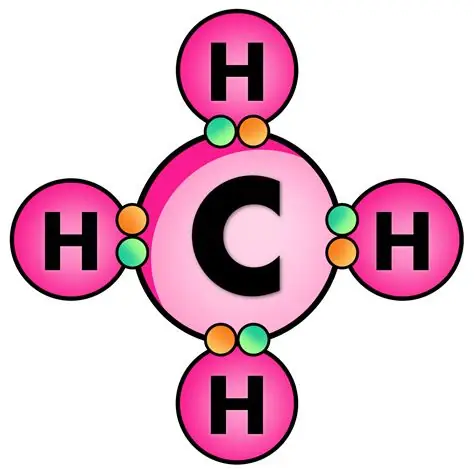
When an atom needs to gain or lose more than two or three electrons, it will generally opt to share what it has. The prime example is carbon, which has four outer electrons. Carbon can get together with up to four other atoms to share electrons. The easiest example is when it combines with hydrogen to form methane.
The outer electron of each hydrogen atom pairs up with one of the carbon valence electrons, giving four pairs in total. Each pair is called a covalent bond. In this way, carbon gets to have eight outer electrons and each hydrogen has its desired two.
Organic Chemistry
Chemistry is divided into three areas or branches:
- Physical chemistry
- Inorganic chemistry
- Organic chemistry
Physical chemistry tends to deal with the physics side of chemistry, while inorganic chemistry looks at pretty much all compounds except those based around carbon and hydrogen.
The area which concerns us is organic chemistry, which centres around hydrogen- and carbon-based compounds (hydrocarbons), but which often includes other elements too, such as oxygen, nitrogen and sulphur. In this sense, “organic” has nothing to do with pesticide-free crops; it has everything to do with the molecules that make up those crops.
Carbon is special because its atoms can bond together to form long chains. This property is essential to life: the plants and animals around us would not exist without it. There are rules governing how carbon compounds are named according to the number of carbon atoms linked in the chain. For now, we will stick with the basics.
Carbon-Chain Prefixes
| Number of carbons | Prefix | Pronunciation (where given) |
|---|---|---|
| 1 | meth | “meeth” |
| 2 | eth | “eeth” |
| 3 | prop | “prope” |
| 4 | but | “bute” |
| 5 | pent | |
| 6 | hex | |
| 7 | hept | |
| 8 | oct | |
| 9 | non | |
| 10 | dec | “deck” |
Bond Notation and Naming
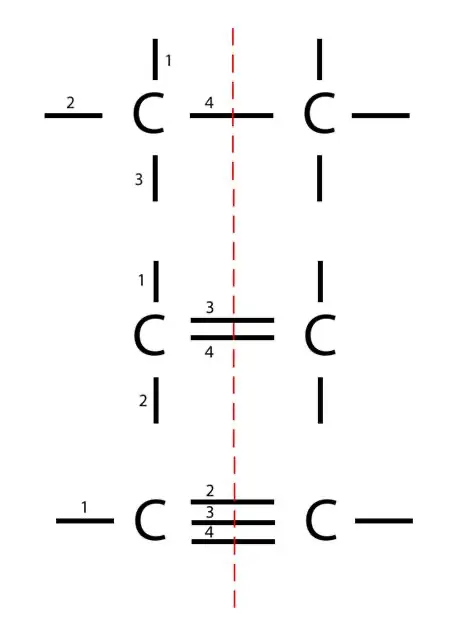
When scientists draw molecules, they use element letters, together with the charges they carry, and/or lines to represent bonds. A covalent bond is represented by a short line, like a dash. Carbon atoms (C) can bond with each other twice or even three times; these are known as double bonds and triple bonds, respectively. A double bond looks like an equals sign and a triple bond is a stack of three dashes.
When the molecule is named, each bond type has an ending. Since the following molecules each have two carbon atoms, they all start with “eth”:
-ane: ethane-ene: ethene-yne: ethyne
Different elements make different numbers of covalent bonds, depending on how many electrons they have in their valence shells.
| Element | Symbol | Typical covalent bonds |
|---|---|---|
| Carbon | C | 4 |
| Hydrogen | H | 1 |
| Oxygen | O | 2 |
| Nitrogen | N | 3 |
| Sulphur | S | 2 |
| Phosphorus | P | 3 |
There are conventions relating to how mixed-element molecules are named:
| Name component | Bond or group shown in the original |
|---|---|
| Hydrocarbon | C-H |
| Amino | N-C |
| Thio | S-C |
| Phospho | P-C |
Biochemistry
When it comes to the substances that make plants and animals, we move to an even more specialised branch called biochemistry. Here we study natural molecules and how they interact to make every living thing work and stay alive.
Examples of these molecules include protein, starch, fat, carbohydrate, chlorophyll, cellulose, haemoglobin and hormones. We will return to these later; first we need to understand how molecules interact and react chemically with each other.
Acids, Bases and Alcohols
The Mole and RAM
Why talk about a small silky-soft creature and a male sheep? These names are not what they might seem, and the concepts may seem strange at first.
A single atom of any substance is far too small to put on a set of scales. We therefore need a practical way of knowing how many atoms or molecules of each substance we are putting into a flask when making chemical reactions.
Avogadro worked out a number, called Avogadro’s constant, which allows us to do this. It hinges on a concept called a mole:
One mole of any substance is approximately
6.023 x 10^23atoms or molecules.
This amount has the corresponding mass shown on the periodic table. For example, one mole of carbon atoms weighs 12.011 g.
The mass of every atom is standardised against carbon and is therefore referred to as relative atomic mass (RAM). Molecules have a relative molecular mass (RMM).
For the Back Pocket
We now know a little about atoms and molecules. We understand what atoms are made of and how and why they end up sticking together, through covalent or ionic bonds. They have mass, which in the real world we can refer to as weight.