Hidden Gems
Clever ways to give even the least enthusiastic fruit and veg eaters plenty of great nutrition. Whilst there’s no guarantee, these are all tried and tested – and you can always tweak them to suit.
There are all manner of amazingly healthy things in the plant world which we really should eat to get the most benefit in terms of adding years to your life and perhaps more importantly, life to your years. We can’t all like every single fruit and vegetable out there, but as adults, we can choose to still go ahead and eat some of our least favourite things anyway or disguise them with strong tasting herbs and spices.
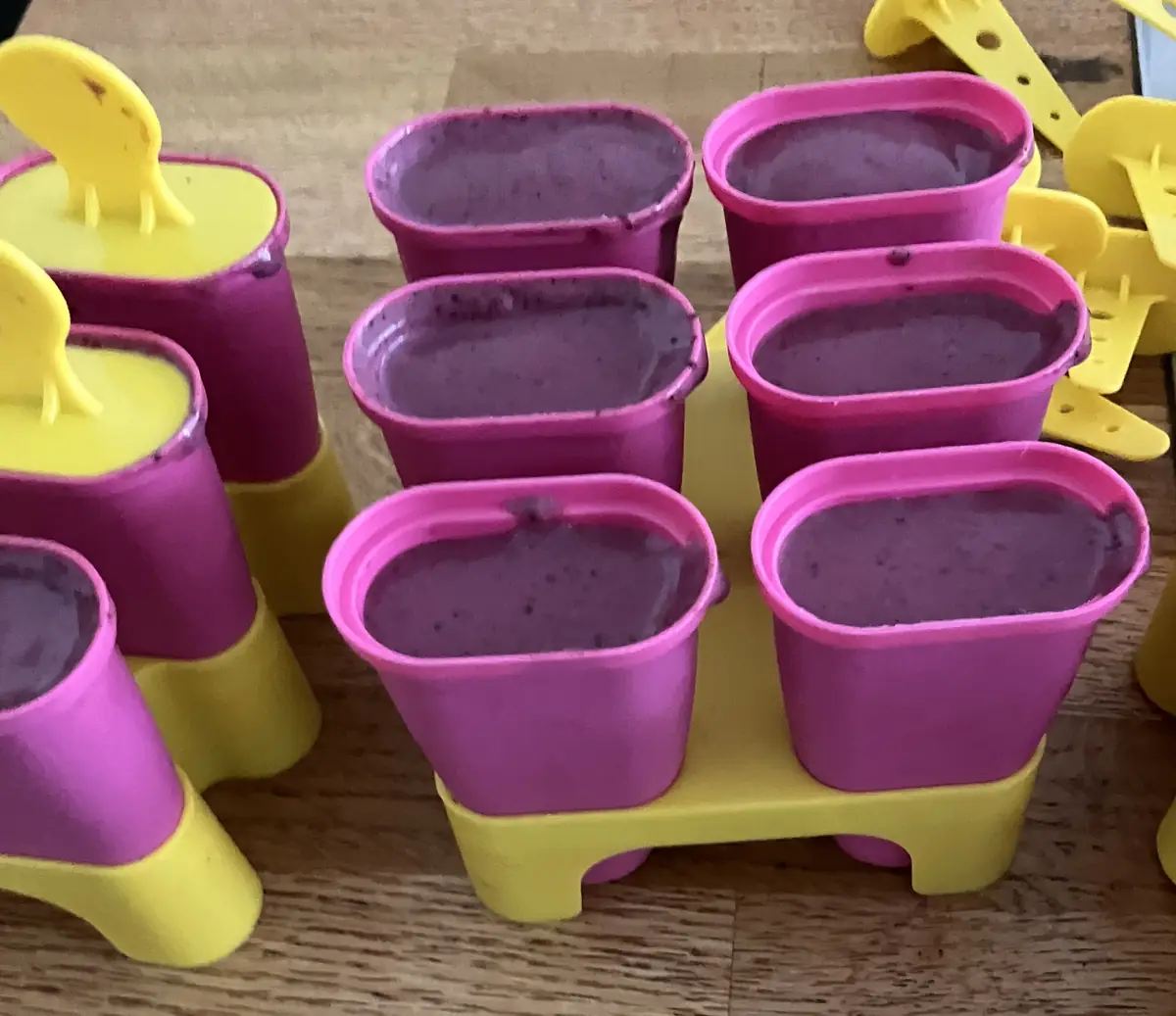
However, children are often a different kettle o’ fish. It is not uncommon to find ours turning their noses up at various dishes simply based on appearance – the subsequent refusal to even taste things can be very frustrating! Our daughter doesn’t like ground flax seed, which really is a must when it comes to omega 3 intake. She’s not keen on walnuts or brazils either and she really doesn’t like blueberries, which are a powerhouse of goodness… but she does like home made frozen fruity lollies, which are the perfect vehicle for all that good stuff she dislikes! We’d certainly recommend getting your own moulds – we’re so glad we did and they’re cheap too! Here’s ours, which we’d just filled:
As we mentioned above, getting all the good stuff into our children (and some adults!) may occasionally require a bit of slight of hand! Whilst this is not an exhaustive list, we have tried to put together a few of our favourite, tried and trusted ideas for packaging fabulously healthy foods in appetising ways. From black beans and chickpeas to kale and avocado, you’ll be amazed at at how easy it is to dress them up in unexpected and tasty ways.
Also, It’s always worth remembering that if we’re trying to consume a recommended amount of something, it doesn’t have to be all crammed into a single meal! The goal is to eat as much of the rainbow as possible over any given week.
What follows are merely some of the things which we have done, so why not experiment for yourselves? There are plenty of ideas on the web too – just be aware that quite a lot of the crumble bars, flapjacks and muffins, etc. are not as healthy as they could be, since they use hard fats like margarine or coconut oil. Perhaps consider using a mild tasting nut or seed butter instead?
Coconut Oil
A quick note about this particular oil… It appears in quite a few vegan recipes because it is solid at room temperature. This means that it is often used (in vegan margarine) as a replacement for butter, or just used straight to give a more solid texture to a dish, particularly deserts/cakes.
There is a belief in some quarters that coconut oil is healthy and even reduces LDL-C levels; unfortunately, being over 90% saturated fat, it actually raises LDL significantly and is in no way health promoting. Along with palm oil (found in pretty much all margarines), it is best avoided!
Flax seed
This really is a super nutritious food and ideally, we should be having some every day – just a couple of heaped teaspoons is plenty. Here are some easy ways of eating without knowing!
Toast: If you’re making toast, simply pop half a teaspoon or so of ground flax on a slice and then spread your desired topping marmite, nut butter or jam etc on and nobody will be any the wiser!
Smoothies: We tend to give our children smoothies in ordinary mugs (which hold just over ¼ litre), so we bung in the equivalent of about one teaspoon of ground flax per mug. It’s particularly good if you blitz seedier berries, like blackberries and strawberries, which renders the flax less noticeable!
Fruity Lollies: As per our separate item on these, this is a great way of getting some ground flax into our little ones – or adults!
Black Beans
These legumes (also known as Turtle Beans) have an abundance of health promoting properties and are a good source of protein, providing around 28g per tin of beans. They are also high in Vit B9 (folate), as well as having a good amount of copper, manganese and Vit B1 (thiamine), amongst others. Like many other legumes, they are rich in antioxidants, flavonoids and fibre. However, not everyone is a fan of their flavour, so there are various ways of making them more appetising!
Brownies: One of our favourite recipes is black bean brownies, which is deeply chocolatey and moreish. There are various recipes around, but for the obvious health reasons, we prefer one which uses a nut butter rather than coconut oil* or margarine. Assuming you divide your tray bake into eight, this will give you about 5g protein per portion. This is one such recipe:
We use this recipe, which is even simpler and very healthy with nearly 7g of protein per portion:
(If you haven’t watched Forks over Knives, then here’s the link to this life changing film
Mousse: This is reminiscent of our much loved avocado mousse – perhaps you could include some avo in your version just for fun? Anyway, this basically uses cashews and almond milk with the beans to make it lovely and creamy. Whilst this method uses raw cacao, you could always substitute some of the cacao for melted dark chocolate… The main thing to remember is that you’re best to soak the cashews so that they blend more easily and try to use a bullet or high-speed blender, which is best for a smooth consistency. Here’s a recipe:
- 1 tin black beans, drained & rinsed well
- 4 tbsp almond butter (or any mild tasting nut or seed butter)
- 2 tbsp date syrup
- 30 ml espresso
- 50 ml plant milk, eg. almond, soya, oat, etc.
- 2 tbsp raw cocao
- A pinch of salt
Pop all the ingredients into a high speed blender and ziz until the mixture is smooth and creamy. Spoon the mixture into whatever small bowls, ramekins or glasses etc that you use for serving and then chill in the fridge for an hour or so to firm the mixture up. Decorate however you please (fresh raspberries look nice) and enjoy!
Alternatively, you could follow this fab three ingredient super-healthy recipe instead – it’s a bit like the peanut butter and banana ice-cream we make.
Chickpeas
Chocolate Hummous: Whilst they are, like all the legumes, a fantastic food, not everyone likes the taste! Maybe just straightforward hummous may be the answer, or if you’re still not keen, then why not try a flavoured version, such as red pepper hummous. Failing that, and particularly when it comes to children, there’s always chocolate hummous – it’s sooo nice and can be used in packed lunches or simply popped on your toast. Mmmmm! Here’s a recipe for it:
Like any recipe, you can play around with it and swap or add ingredients – why not try some 70-80% dark chocolate melted into the mixture rather than all raw cacao? If you fancy making it a bit Mexican, then add a small (!) amount of cayenne – remember, you can always add more, but once it’s in and mixed, there’s no going back!! Using almond butter can add another dimension to it. Whatever you end up doing, we hope you enjoy this lovely treat!
Pancakes: Another little trick is to add some gram (chickpea) flour to your pancake mix – you could start with say, ¼ gram flour and ¾ plain flour and see what you think. Just be aware that gram flour has quite a distinctive taste, so probably better to start off small and then mess around with the ratio and see what works for you. maybe spread some chocolate hummous on them! A nice topping is a berry compote – basically warm some frozen mixed berries, blitz them with a hand (stick) blender and add date or maple syrup to taste; bingo you’ve got a lovely breakfast or dessert.
Other Legumes
Adzuki beans are another brilliant food and are very popular in a sweet form called Anko in many East Asian countries. I link here a recipe for a lovely healthy chocolatey creamy adzuki bean spread:
Lentils
The humble red lentil is a little miracle of nature – so small, but rich in iron, copper, phosphorous, folate and fibre. They also contain polyphenols, saponins, phytosterols and a variety of other beneficial phytochemicals. There’s even been some research on their health benefits:
Mustafa AM, Abouelenein D, Acquaticci L, Alessandroni L, Angeloni S, Borsetta G, Caprioli G, Nzekoue FK, Sagratini G, Vittori S. Polyphenols, Saponins and Phytosterols in Lentils and Their Health Benefits: An Overview. Pharmaceuticals (Basel). 2022 Oct 3;15(10):1225.
The great thing about lentils is their versatility, particularly red lentils, is their ability to blend into (and thicken, if required) almost any sauce. Here are some ideas.
Lasagne: Just make your usual tomato sauce for the lasagne, but throw in a cup or so of red lentils right from the start. They’ll cook through and lend a ‘bolognesey’ texture to the mixture after only about 20mins – it’s worth noting that they take a little longer this way than if they were cooked separately. Although this is an option (then adding them to your sauce), they absorb more flavour the first way. If you want to create a beefy flavour, just pop in a teaspoon or two of yeast extract. For a lovely creamy, vegan cheese sauce, look here:
Chilli: This work on the same principle as the lasagne/bolognese sauce – add the red lentils iwith the wet ingredients and simmer until soft. This time yeast extract is a must and for some treaty, Mexican mole-like extra depth, add a tablespoon or two of raw cacao – or you could melt in some 80% dark chocolate… sooo nice!
Burger: There are loads of lentil based burger recipes, using not only red, but also green or brown lentils. The vital bit is the binder, which is usually something like chia or ground flax seeds.
These are just a tiny number of the myriad of possible sweet and savoury soups, dips and other dishes which you can create to deliver beans, peas and lentils in an appetising and enjoyable way. Have fun with pulses and peas and just experiment – you never know, you may come up with an amazing new dish of your own!
Kale and Spinach
Although I’ve singled out these two, this is because taste-wise, they’re easy to hide in smoothies! Feel free to try a handful of other leafy greens instead – pak choi should work as well as lambs lettuce and cauliflower leaves perhaps.
Smoothie: We’ve found that a good handful of greens can be blended in very nicely with some berries and banana to deliver a good tasting power house of nutrition! Whilst we don’t use any particular recipe, one thing that’s worth noting is that if you use the kale stalks as well, it’s best to give the greens a really good blitz with some plant milk before adding the fruit – dark berries are best for flavour and hiding the green colour! Either way, we tend to blend greens and a couple of mugs of plant milk first and then add the berries and banana for a shorter second blend. High speed blending does tend to make stuff a bit warm, so to make it thicker and cooler, just use frozen fruit.
Avocado
Although a relatively fatty food, the fats are healthy ones. Obviously one can turn these lovely fruits into guacamole, but where the look and taste doesn’t appeal, there are some imaginative alternative ways of getting someone to eat avocado unknowingly and enthusiastically!
Mousse: This doesn’t really need much explaining – just make sure that the avos are soft and ripe. The more portions you make, the easier it is, since you’ll use a hand (stick) blender to purée the avocado and that’s harder with just one! If you work on about ⅔ of a medium avo per adult or about ½ per child, that should be roughly right.
Ziz the avocados for a few seconds to start them off and then pop in your raw cacao and maple syrup – start with around a heaped teaspoon of cacao and a glug of maple, blitz until smooth and then taste. If you fancy a richer mousse, blend in a little more cacao, and if you want it sweeter, well you know what to do! As mentioned before, add a little at a time since you can always add more, but you can’t take it back out if you’ve over done it. Spoon into your serving glasses or ramekins and chill for about an hour. It looks great in small cocktail glasses by the way. Decorate in a way that pleases you (maybe fresh berries, chocolate shavings or shredded coconut) and enjoy!
Smoothie: Why not put an avocado into your berry smoothie?
A Jolly Healthy Lolly
As per our remarks at the start, here’s our fruity lolly recipe. To make about 18 medium lollies, we do the following:
For each lolly we pop into a jug; about 1/2 walnut, 1 almond, 1/2 small Brazil and about 1/2 teaspoon of ground flax. These are soaked in almond or soya milk, just enough to cover them. Of course you can use whatever nuts and plant milks you like, but we use these because they have such good nutrient profile. After a couple of hours or so, tip the nuts and milk into a blender (a high speed bullet type if possible) and ziz for about 40 seconds or so until fairly smooth. You can skip this step and just add the nuts and milk straight in with the fruit – we just found the lolly mix is a bit smoother and nicer when you pre-blend the nuts.
Into a large blender goblet add about 1/2 of a 500g pack of frozen mixed berries, a couple of handfuls of frozen blueberries and a banana. Pour in the nut mixture and top up with about 200ml of plant milk – this is handy to rinse out the bullet. Don’t worry about exact measures since you can always add more milk or more berries to alter the consistency. Blend to give a ‘just pourable’ mixture; if you need to take the tart edge off the fruity slush, add some date syrup (or equivalent) to taste – remember, it’s not supposed to be too sweet!
Finally, pour into your waiting moulds, pop the stick/handles in and put in the freezer to set. Now your children have a treat that you’ll feel good about giving them!
Remember, these are your lollies for your children (or yourselves!), so tailor them to your taste! If you use a lot of very ‘seedy’ berries such as blackberries and/or flax, you may find the result ‘bitty’ since the tiny seeds survive even bullet blending. Experiment with small batches until you get your ‘Goldilocks’ blend and then you’re away!
We’ll be popping a lolly making video soon!